The Case
The Reef State campaign recognises the precedence of the New England State Movement and the failed 1967 New England (Australia) statehood referendum held in New South Wales. The observation from this failed referendum is the need for the Reef State new state movement to clearly outline all the characteristics of what the agreed upon new state would look like prior to a referendum to avoid manipulation from the government of the day to quash the referendum.
Geography
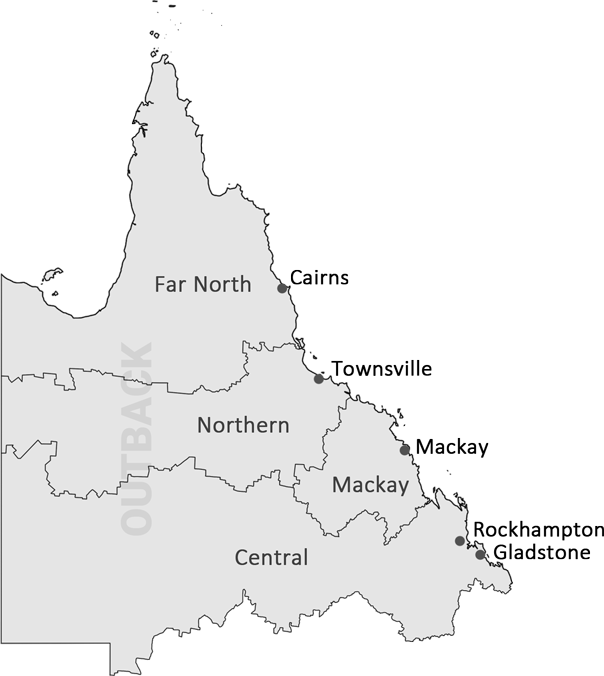
The Reef State can be broken down into four major regions, and the four regions have their own naturaly formed inherit capital (See Map 1.). Each region has its own individual characteristics and the four regions have a long history of competition. Due to this competition there will need to be an agreement to work together to form the Reef State. There is a fifth region which is formed from parts of the four regions called the Outback. The Outback has no inherit capital.
- Far North - Capital Cairns
- Northern - Capital Townsville
- Mackay - Capital Mackay
- Central - Capitals Rockhampton/Gladstone
- Outback
Map 1. Reef State Regions and their Capitals.
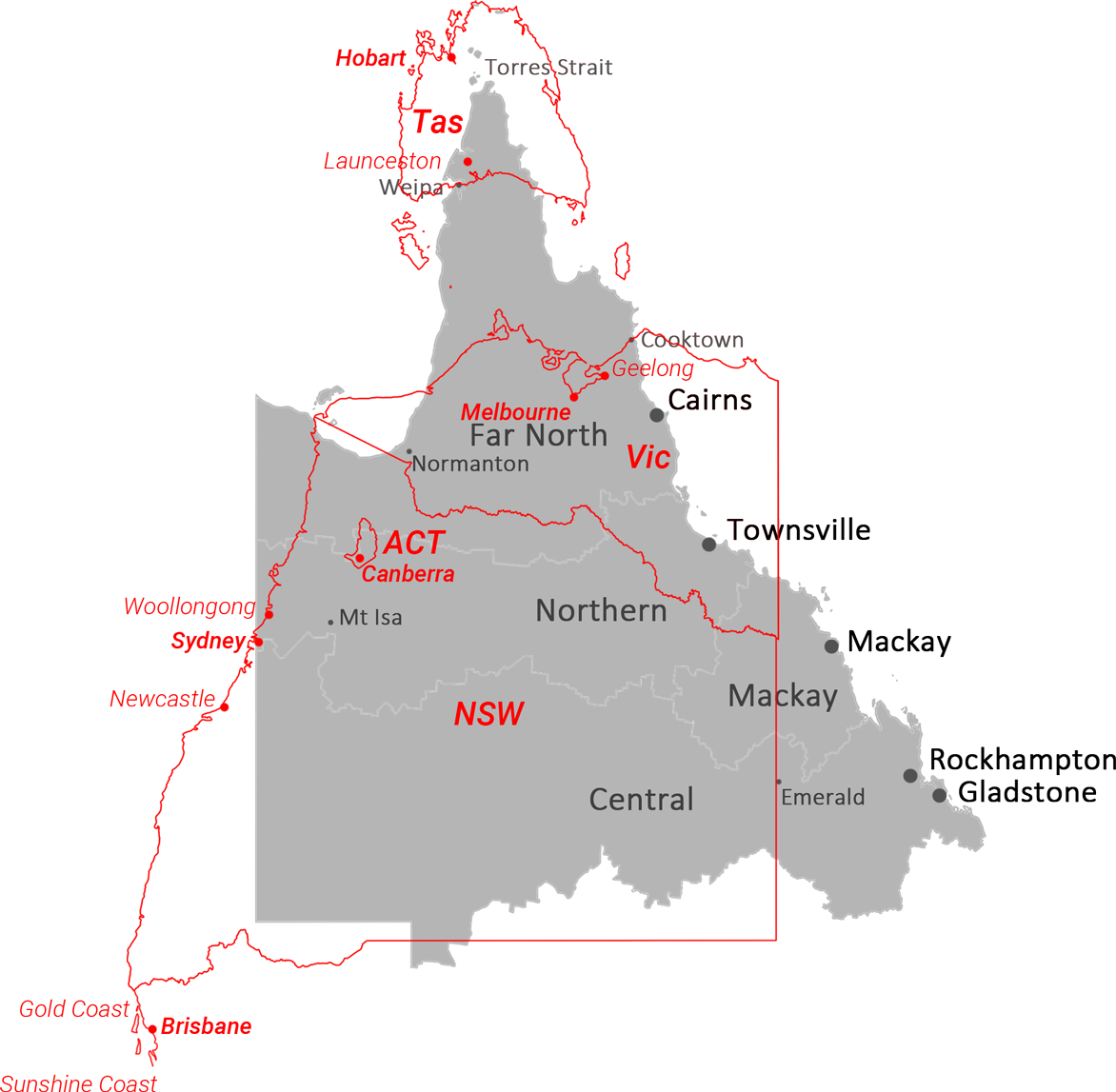
Map 2. Reef State Compared with NSW, ACT, Vic, Tas.
How did these regions evolve?
Historically, as the State grew, strategic seaports and service centres established themselves northward along the coast, to better service the areas north of Brisbane.
The ports established themselves naturally, initially because they provided superior safe anchorages required by the transport technology of the time to move freight and people via sea to and from their regions.
Railway lines (the best land transport technology of the time), were built to move freight and passengers from these ports and centres into their regional hinterlands. Further on in time, as road technology improved, this was complemented by road transport. Major regional airports were established as air transport technology developed.
Over the years, these ports/centres grew as major service hubs effectively becoming regional capital cities bringing higher order metropolitan type services to their regions. This, in turn, reduced costs of living and doing business, improving feasibility of developing the State’s large, previously underdeveloped agriculture and minerals, marine and tourism resources – a process that in the 1950s to 1990s, changed Queensland from being the “Cinderella State” to being a leader in national development.
As population grew, this regional structure has continued to consolidate with road and rail networks (and in the larger northern regions air service networks), radiating out from their hub cities with growing connections to the rest of Australia and overseas.
These regional areas form the backbone of Queensland’s economy accounting for the great bulk of the State’s earnings from overseas and the rest of Australia.
Diminishing Representation
Primary Industries
Government Revenue
Population
Border
Capital
Flag
State Name
2nd Phase Statehood
Contact
President:
Bill Bates,
Mobile: 0447 958 455
Email: president@rexit.au
Mailing Address:
The Secretary,
REXIT (Qld).
PO. Box 94, Edge Hill, 4870
REXIT.AU ABN 45 434 420 070
Links
The Reef State
Membership
Donate
Case
Pathway
History
1890 Central Queensland Seperation Petition